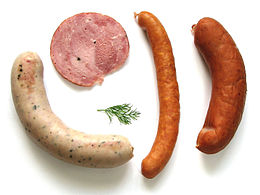
Source : wikipedia
A sausage is a food usually made from ground meat with a skin around it. Typically, a sausage is formed in a casing traditionally made from intestine, but sometimes synthetic. Some sausages are cooked during processing and the casing may be removed after.
History
Sausage making is a logical outcome of efficient
butchery. Traditionally, sausage makers would
salt various
tissues and
organs such as scraps,
organ meats,
blood, and
fat to help preserve them. They would then stuff them into tubular casings made from the cleaned intestines of the animal, producing the characteristic cylindrical shape. Hence, sausages,
puddings, and
salami are among the oldest of prepared foods, whether cooked and eaten immediately or dried to varying degrees.
The word
sausage is derived from
Old French saussiche, from the
Latin word
salsus meaning "salted".
[2]
Pâté is a similar product made of cooked and minced meat. See also,
terrine.
Casings
Traditionally, sausage casings were made of the cleaned intestines, or stomachs in the case of
haggis and other traditional puddings. Today, however, natural casings are often replaced by
collagen,
cellulose, or even
plastic casings, especially in the case of
industriallymanufactured sausages. Some forms of sausage, such as
sliced sausage, are prepared without a casing. Additionally,
luncheon meat and sausage meat are now available without casings in
tin cans and
jars.
Ingredients
A sausage consists of meat, cut into pieces or ground, and filled into a casing, with other ingredients. Ingredients may include a cheap
starch filler such as breadcrumbs, seasoning and flavourings such as
spices, and sometimes others. The meat may be from any animal, but often is
pork,
beef, or
veal. The lean meat-to-fat
ratio is dependent upon the style and producer. Speciality sausages with other ingredients such as apple and leek are also made.
[3] The meat content as labelled may exceed 100%; this happens when the weight of meat used exceeds the total weight of the sausage after it has been made, sometimes including a drying process which reduces water content.
In some jurisdictions foods described as sausages must meet regulations governing their content. For example, in the United States The
Department of Agriculture specifies that the fat content of different defined types of sausage may not exceed 30%, 35% or 50% by weight; some sausages may contain binders or extenders.
[4][5]
Many traditional styles of sausage from
Europe and
Asia use no
bread-based filler and include only meat (lean meat and fat) and flavorings.
[6] In the United Kingdom and other countries with
English cuisine traditions, many sausages contain a significant proportion of bread and starch-based fillers, which may comprise 30% of ingredients. The filler used in many sausages helps them to keep their shape as they are cooked. As the meat contracts in the
heat, the filler expands and absorbs moisture and fat from the meat.
[7]
When the food processing industry produces sausages to a price, almost any part of the animal can end up in sausages, varying from cheap, fatty specimens stuffed with meat blasted off the carcasses (
mechanically recovered meat, MRM) and
rusk, while the finest quality contain only meat and seasoning.
[3] In Britain "meat" declared on labels could in the past include fat, connective tissue, and MRM; these ingredients may still be used, but must be labelled as such, and up to 10% water may be included without being labelled.
[7]
Classifications
Sausages classification is subject to regional differences of opinion. Various metrics such as types of ingredients, consistency, and preparation are used. In the
English-speaking world, the following distinction between
fresh,
cooked, and
dry sausages seems to be more or less accepted:
- Cooked sausages are made with fresh meats, and then fully cooked. They are either eaten immediately after cooking or must be refrigerated. Examples include hot dogs, Braunschweiger, and liver sausage.
- Cooked smoked sausages are cooked and then smoked or smoke-cooked. They are eaten hot or cold, but need to be refrigerated. Examples include kielbasa and mortadella. Some are slow cooked while smoking, in which case the process takes several days or longer, such as the case for Gyulai kolbász.
- Fresh sausages are made from meats that have not been previously cured. They must be refrigerated and thoroughly cooked before eating. Examples include Boerewors, Italian pork sausage, siskonmakkara, and breakfast sausage.
- Fresh smoked sausages are fresh sausages that are smoked and cured. They do not normally require refrigeration and do not require any further cooking before eating. Examples include Mettwurst and Teewurst which are meat preparations packed in sausage casing but squeezed out of it (just like any other spread from a tube).
- Dry sausages are cured sausages that are fermented and dried. Some are smoked as well at the beginning of the drying process. They are generally eaten cold and will keep for a long time. Examples include salami, Droë wors, Finnish meetvursti, Sucuk, Landjäger(smoked), Slim Jim, and summer sausage.
- Bulk sausage, or sometimes sausage meat, refers to raw, ground, spiced meat, usually sold without any casing.
- Vegetarian sausage are made without meat, for example, based on soya protein or tofu, with herbs and spices. Some vegetarian sausages are not necessarily vegan, and may contain ingredients such as eggs.
Other countries use different systems of classification. Germany, for instance, which produces more than 1200 types of sausage, distinguishes raw, cooked and precooked sausages.
- Raw sausages are made with raw meat and are not cooked. They are preserved by lactic acid fermentation, and they may be dried,brined or smoked. Most raw sausages will keep for a long time. Examples include Mettwurst and salami.
- Cooked sausages may include water and emulsifiers and are always cooked. They will not keep long. Examples include cervelat,Jagdwurst, and Weißwurst.
- Precooked sausages (Kochwurst) are made with cooked meat but may also include raw organ meat. They may be heated after casing, and they will keep only for a few days. Examples include Saumagen and Blutwurst.
In
Italy, the basic distinctions are:
- Raw sausage (salsiccia) with a thin casing
- Cured and aged sausage (salsiccia stagionata or salsiccia secca)
- Cooked sausage (wuerstel)
- Blood sausage (sanguinaccio or boudin)
- Liver sausage (salsiccia di fegato)
- Salami (in Italy, salami is the plural of salame, a big, cured, fermented and air-dried sausage)
- Cheese sausage (casalsiccia) with cheese inside
Certain countries classify sausage types according to the region in which the sausage was traditionally produced:
- France: Montbéliard, Morteau, Strasbourg, Toulouse,..
- Germany: Frankfurt am Main, Thuringian sausage, Nuremberg, Pomerania, ..
- Austria: Vienna, ..
- Italy: Merano (Meraner Wurst)
- UK: Cumberland, Chiltern, Lincolnshire, Glamorgan, ..
- Slovenia: Kranjska (klobasa), after the Slovenian name for the province of Carniola
- Spain: botifarra catalana, chorizo riojano, chorizo gallego, chorizo de Teror, longaniza de Aragón, morcilla de Burgos, morcilla de Ronda, morcilla extremeña, morcilla dulcecanaria, llonganissa de Vic, fuet d'Olot, sobrassada mallorquina, botillo de León, llonganissa de Valencia, farinato de Salamanca, ..
- Poland: kiełbasa krakowska (Kraków-style), toruńska (Toruń), żywiecka (Żywiec), bydgoska (Bydgoszcz), krotoszyńska (Krotoszyn), podwawelska (literally: "from underWawel"), zielonogórska (Zielona Góra), rzeszowska (Rzeszów), śląska (Silesia), swojska, wiejska, jałowcowa, zwyczajna, polska, krajańska, szynkowa, parówkowa.
- Hungary: kolbász gyulai (after the town of Gyula), csabai (after the city of Békéscsaba), Debrecener (after the city of Debrecen).
- Serbia: Sremska kobasica, Sremska salama, Sremski kulen (after the region of Srem/Sirmium), Požarevačka kobasica (after the city of Požarevac)
National varieties
Many nations and regions have their own characteristic sausages, using meats and other ingredients native to the region and employed in traditional dishes.
Africa
North Africa
Merguez is a red, spicy sausage from Morocco, Algeria, Tunisia and Libya, North Africa. It is also popular in France, Israel and the German state of Saarland, where it is often grilled on a
Schwenker. Merguez is made with lamb, beef, or a mixture of both. It can be flavored with a wide range of spices, such as sumac for tartness, and paprika, Cayenne pepper, or
harissa, a hot chili paste that gives it a red color. It is stuffed into a lamb casing, rather than a pork casing. It is traditionally made fresh and eaten grilled or with couscous. Sun-dried merguez is used to add flavor to tagines. It is also eaten in sandwiches.
South Africa
In
South Africa, traditional sausages are known as
boerewors or farmer's sausage. Ingredients include game and beef, usually mixed with pork or lamb and with a high percentage of fat. Coriander and vinegar are the two most common seasoning ingredients, although many variations exist. The coarsely-ground nature of the meat as well as the long continuous spiral of sausage are two of its recognisable qualities. Boerewors is traditionally cooked on a
braai (
barbecue).
Droë wors is an uncooked sausage similar to boerewors made in a dry-curing process similar to
biltong.
A local variant of the
hot dog is the "Wors roll", or boerewors roll. This is a hotdog bun with a piece of boerewors in, served with a tomato and onion relish called
seshebo. Seshebo can include chilli, atchaar or curries, depending on the area within the country.
Asia
China
A European-like-style smoked savory
hóng cháng (红肠
red sausage) is produced in Harbin, China's northernmost major city.
[8] It is another notable product similar to Lithuanian and Polish sausages including
kiełbasa and
podhalańska, in that they tend to be of a much more European flavours than other Chinese sausages. This kind of sausage was first produced in a Russian-capitalized factory named Churin sausage factory in 1909, Since then Harbin style sausage become popular in China, especially in northern regions.
[8]
Lap cheong (also lap chong, lap chung, lop chong) are dried pork sausages that look and feel like pepperoni, but are much sweeter. In southwestern China, sausages are flavored with salt, red pepper and wild pepper. People often cure sausages by smoking and air drying.
Japan

Japanese
arabiki pork sausages served with scrambled eggs in a restaurant in
Chiang Mai, Thailand
Although
Japan is not traditionally known for beef, pork, venison, or even blood sausages, the Japanese do consume a fish-based log called
kamaboko, which could be considered a type of sausage. Kamaboko is made with cured ground fish paste called
surimi. It is usually shaped into half-moons on top of a small plank of wood and the outside dyed pink. When the kamaboko is cut into slices it appears to have an unmistakable pink rind which surrounds a white interior. It is often cut into thin slices and added to soups, salads,
bento, and many other dishes as a garnish. In recent years, kamaboko has also entered the market as a snack food. Similar to the
Slim Jim, cheese, sausage, and fish flavored kamaboko sticks can be found in convenience stores across Japan.
Korea
Sundae, a form of blood sausage, is a traditional Korean sausage. A popular street food, sundae is normally prepared by steaming or boiling cow or pig intestines stuffed with various ingredients. The most common variation is composed of pork blood,
cellophane noodle, sliced
carrot and
barley stuffed into pig intestines, but other regional variations include
squid or
Alaska pollock casings. Sundae is eaten plain with salt, in stews, or as part of a stir-fry.
Philippines
In the Philippines, there are different kinds of sausages called
longaniza (
Filipino languages:
longganisa) with mixes dependent on their size of origin:
Longaniza de Vigan (
longganisang Vigan),
Longaniza de Lucban (
longganisang Lucban), and
Longaniza de Cebu (
longganisang Sugbo/Cebu) are examples.
While
longganisa is widely accepted as the term for native sausages, in some parts of the Visayas and Mindanao
chorizo (
Visayan:
tsoriso) is a more common term. There are regional varieties such as
Vigan (with lots of garlic and not sweet) and
Lucban (lots of oregano and pork fat is chunky). Most
longganisas contain Prague powder and are hardly smoked and usually sold fresh. In general there are several common variants:
- matamis, sweet
- jamonado or hamonado, with lots of garlic, black pepper and other spices
- skinless, sans the usual natural casing and rolled in plastic sheets
- Chorizo de Macao (in reference to Macao. sweet and dried with lots of chunky fat and also identified with the red colored abacá twine)
- Chorizo de Bilbao, with lots of paprika and usually kept in a can with lard. The best and most popular brand is Marca el Rey; contrary to popular belief that it comes fromBilbao, this is manufactured in the United States. Chorizo de Bilbao seems to be a purely Filipino term as the variant does not exist in Spain.
Thailand

Sai krok Isan being freshly grilled at a market in
Uttaradit, Thailand
Also very popular in Thailand is
naem, a raw fermented pork sausage similar to the
Vietnamese nem chua and
Laotian som moo. This variety of sausage is often encountered as
yam naem and
naem khluk, both of which are Thai salads. Adopted from Vietnam comes
mu yo. It is somewhat similar in taste and texture to
liverwurst and, served with a
nam chim (Thai dipping sauce), a popular snack in Thailand. It too can be used as an ingredient for Thai salads and as a meat ingredient in, for instance, Thai soups.
Kun chiang is a dry and sweet
Chinese sausage which has also been incorporated into the Thai culinary culture. Known as
lap cheong by
Cantonese, in Thailand it is most often used, again, as an ingredient for a Thai salad,
yam kun chiang, one that is normally only eaten together with
khao tom kui, a plain rice
congee. A host of modern, factory-made, sausages have become popular as snacks in recent years. These most often resemble hot-dogs and frankfurters and are commonly sold grilled or deep-fried at street stalls, and served with a sweet, sticky and slightly spicy soy-based sauce.
Vietnam
Eurasia
Turkey
In
Turkey, sausage is known as
sosis, which is made of beef.
Sucuk (pronounced tsudjuck or
sujuk with accent on the last syllable) is a type of sausage made in Turkey and neighboring Balkan countries.
There are many types of sucuk, but it is mostly made from beef. It is fermented, spiced (with garlic and pepper) and filled in an inedible casing that needs to be peeled off before consuming. Slightly smoked sucuk is considered superior. The taste is spicy, salty and a little raw, similar to pepperoni. Some varieties are extremely hot and/or greasy. Some are "adulterated" with turkey, water buffalo meat, sheep fat or chicken.
There are many dishes made with sucuk, but grilled sucuk remains the most popular. Smoke dried varieties are consumed "raw" in sandwiches. An intestinal loop is one sucuk. Smoked sucuk is usually straight.
Europe
Britain and Ireland
In the
UK and
Ireland, sausages are a very popular and common feature of the national diet and popular culture.
British sausages
[11] and Irish sausages are normally made from raw (i.e., uncooked, uncured, unsmoked) pork, beef, venison or other meats mixed with a variety of herbs and spices and cereals, many recipes of which are traditionally associated with particular regions (for example
Cumberland sausages). They normally contain a certain amount of
rusk or
bread-rusk, and are traditionally cooked by frying, grilling or baking. They are most typically 10–15 cm long, the filling compressed by twisting the casing into concatenated "links" into the sausage skin, traditionally made from the prepared
intestine of the slaughtered animal; most commonly a pig.
Due to their habit of often exploding due to shrinkage of the tight skin during cooking, they are often referred to as
bangers, particularly when served with the most common accompaniment of mashed potatoes to form a bi-national dish known as
bangers and mash. (The designation
banger was in use at least as far back as 1919 and is often said to have been popularized in
World War II, when scarcity of meat led many sausage makers to add water to the mixture, making it more likely to explode on heating.)
[12] There are currently organizations in a number of UK counties, such as
Lincolnshire, which are seeking European
Protected designation of origin (PDO) for their sausages so that they can be made only in the appropriate region and to an attested recipe and quality.
[13]
Famously, they are an essential component of a
full English or Irish breakfast. Some are made to traditional regional recipes such as those from
Cumberland or
Lincolnshire, and increasingly to modern recipes which combine fruit such as apples or apricots with the meat, or are influenced by other European styles such as the Toulouse sausage or
chorizo.
Vegetarian sausages are also now very widely available, although traditional meatless recipes such as the Welsh
Selsig Morgannwg also exist.
In most areas, "sausage meat" for frying and
stuffing into poultry or other meats is sold as ground, spiced meat without casing.
Battered sausage, consisting of a sausage dipped in batter, and fried, is sold throughout Britain from
Fish and Chip shops. In England, the
saveloy is a type of pre-cooked beef sausage, larger than a typical hot-dog, which is served hot. A saveloy skin was traditionally colored with
bismarck-brown dye giving saveloy a distinctive bright red color. Saveloys are free of pork, and may be
kosher and eaten by
Jews.
A thin variety of sausage, known as the
chipolata is often wrapped in bacon and served alongside roast
turkey at
Christmas time and are known as
Pigs in a Blanket or "Pigs in Blankets". They are also served cold at children's parties throughout the year. The word derives from the Italian "cipolatta", "onioned" or made with onion, although its meaning has been forgotten and it need not contain onion.
Following concerns about health and user preference (distaste for horsemeat), heightened by the
BSE crisis in the 1990s and the 2013
horsemeat scandal, the quality of the meat content in many British sausages improved with a return to the artisanal production of high quality traditional recipes, which had previously been in decline. However, many cheaper sausages contain
mechanically recovered meat or
meat slurry, which must be so listed on packaging.
There are various laws concerning the meat content of sausages in the UK. The minimum meat content to be labelled Pork Sausages is 42% (30% for other types of meat sausages), although to be classed as meat, the Pork can contain 30% fat and 25% connective tissue. Often the cheapest supermarket pork sausages do not have the necessary meat content to be described as "pork sausages" and are simply labelled "sausages"; with even less meat content they are described as "bangers" (an unregulated name).
[14]These typically contain
MRM which was previously included in meat content, but under later EU law cannot be so described.
[15][16]
Scotland
Haggis is generally recognized as the national dish, although not described as a sausage. A popular breakfast food is the
square sausage. This is normally eaten as part of a full
Scottish Breakfast or on a Scottish morning roll. The sausage is produced in a rectangular block and individual portions are sliced off. It is seasoned mainly with pepper. It is rarely seen outside Scotland and in fact is still fairly uncommon in the
Highlands.
[citation needed] Other types of sausage include
black pudding, similar to the German and Polish blood sausages.
Stornoway black pudding is held in high regard and measures are currently being taken to bring it under EU geographical protection. Additionally a popular native variety of sausage is the
red pudding. It is usually served in
chip shops, deep fried in batter and with chips as a red pudding supper.
Bulgaria
Lukanka (Луканка) is a spicy salami sausage unique to Bulgarian cuisine. It is similar to
sujuk, but often stronger flavored.
Croatia / Serbia
Kulen is a type of flavored sausage made of minced pork that is traditionally produced in Croatia (Slavonia) and Serbia (Vojvodina), and its designation of origin has been protected. The meat is low-fat, rather brittle and dense, and the flavor is spicy. The red paprika gives it aroma and color, and garlic adds spice. The original kulen recipe does not contain black pepper because its hot flavor comes from hot red paprika.
Other types of sausages in Serbia include Sremska, Požarevačka, and Sudžuk. And other types of sausages in Croatia include Češnjovka (Garlic Sausage) and Krvavica (a variation on Blood Sausage).
Finland
Finnish makkara is typically similar in appearance to Polish sausages or
bratwursts, but have a very different
taste and
texture.
Nakki is a tinier edition of
makkara. There is a variety of different
nakkis varying almost as much as different types of
makkara. The closest relative to
nakki is the thin
knackwurst.
Most
makkara has very little
spice and is therefore frequently eaten with
mustard,
ketchup, or other table condiments without a bun. Makkara is usually
grilled, roasted over coals or open fire, steamed (called
höyrymakkara) or cooked on
sauna heating stones.
Siskonmakkara, a finely ground light-colored sausage is usually encountered in the form of soup,
siskonmakkarakeitto.
When a steak made out of thick (diameter about 10 cm (3.9 in))
makkara is prepared inside a sliced, fried bun with cucumber salad and other fillings, it becomes a
porilainen after the town of
Pori.
Pickled makkara intended to be consumed as slices is called
kestomakkara. This class includes various
mettwurst, salami and Balkanesque styles. The most popular
kestomakkara in Finland is
meetvursti (etymologically this word comes from
mettwurst), which contains finely ground full meat, ground fat and various spices. It is not unlike salami, but usually thicker and less salty.
Meetvursti used to additionally contain horse meat, but only a few brands contain it anymore, mostly due to the high cost of production. In general, there is no taboo against eating horse meat in Nordic countries, but the popularity has decreased with decreasing availability of suitable horse meat. There is also
makkara and
meetvursti with game, like
deer,
moose or
reindeer meat. Even a
lohimakkara, i.e.,
salmon sausage, exists.
In Finland there are b- and a-classes of BBQ Sausages like Kabanossi, Camping and HK Sininen Lenkki, Blue Loop.
France and Belgium
Saucisson is perhaps one of the most popularized forms of dried sausage in France, with many different variations from region to region. Usually saucisson contains pork, cured with a mixture of salt, wine and/or spirits. Regional varieties sometimes contain more unorthodox ingredients such as nuts and fruits. Other French sausages include the
diot and various types of
boudin.
Germany
Greece
Loukaniko is the common Greek word for pork sausage, but in English it refers specifically to Greek sausages flavored with
orange peel,
fennel seed and other herbs.
Hungary
Hungarian sausages, when smoked and cured, are called
kolbász – different types are often distinguished by their typical regions, e.g.
gyulai and
csabai sausage. As no collective word for "sausage" in the English sense exists in Hungarian, local salamis (see e.g.
winter salami) and boiled sausages "hurka" are often not considered when listing regional sausage varieties. The most common boiled sausages are rice liver sausage ("Májas Hurka") and blood sausage ("Véres Hurka"). In the first case, the main ingredient is liver, mixed with rice stuffing. In the latter, the blood is mixed with rice, or pieces of bread rolls. Spices, pepper, salt and marjoram are added.
Italy
Italian sausages (
salsiccia – pl. "salsicce") are often made of pure pork. Sometimes they may contain beef.
Fennel seeds and chilli are generally used as the primary spice in the South of Italy, in
Puglia they are called "Zampina", black pepper and garlic in the center and North.
Macedonia
Macedonian sausages (
kolbas, lukanec) are made from fried pork,
onions, and
leeks, with herbs and spices.
Malta
Maltese sausage (
Maltese:
Zalzett tal-Malti) is made of pork, sea salt, black peppercorns, coriander seeds and parsley. It is short and thick in shape and can be eaten grilled, fried, stewed, steamed or even raw when freshly made. A barbecue variety is similar to the original but with a thinner skin and less salt.
Netherlands
Dutch cuisine is not known for its abundant use of sausages in its traditional dishes. Nevertheless the Dutch have a number of sausage varieties, such as the
rookworst (smoked sausage) and
Slagersworst (lit. Butchers Meat or sausage) mostly found at the specialist butcher shops and still made by hand and spiced following traditionally family recipes. Another common variety in the Netherlands is the
runderworst which is made from
beef and the dried sausage known as
metworst or
droge worst. The Dutch
braadworst's name might suggest it being a variant of the
bratwurst, but this is not the case and it is closely related to the well known
Afrikaner Boerewors.
Nordic countries
Nordic sausages (
Danish:
pølse,
Norwegian:
pølsa/pølse/pylsa/korv/kurv,
Icelandic:
bjúga/pylsa/grjúpán/sperðill,
Swedish:
korv) are usually made of 60–80% very finely ground
pork, very sparsely spiced with
pepper,
nutmeg,
allspice or similar sweet spices (ground
mustard seed, onion and sugar may also be added). Water, lard, rind,
potato starch flour and soy or milk protein are often added for binding and filling. In southern Norway, grill and wiener sausages are often wrapped in a potato lompe, a kind of
lefse.
Virtually all sausages will be industrially precooked and either fried or warmed in hot water by the consumer or at the
hot dog stand. Since hot dog stands are ubiquitous in
Denmark (known as
Pølsevogn) some people regard
pølser as one of the
national dishes, perhaps along with
medisterpølse, a fried, finely ground pork and bacon sausage. The most noticeable aspect of Danish boiled sausages (never the fried ones) is that the cover often contains a traditional bright-red dye. They are also called
wienerpølser and legend has it they originate from
Vienna where it was once ordered that day-old sausages be dyed as a means of warning. The
Swedish falukorv is a similarly red-dyed sausage, but about 5 cm thick, usually baked in the oven coated in mustard or cut in slices and fried. Unlike ordinary sausages it is a typical home dish, not sold at hot dog stands. Other Swedish sausages include
prinskorv,
fläskkorv,
köttkorv (sv) and
isterband; all of these, in addition to
falukorv, are often accompanied by
potato mash or
rotmos (a root vegetable mash) rather than bread. In
Iceland,
lamb may be added to sausages, giving them a distinct taste. Horse sausage and mutton sausage are also traditional foods in Iceland, although their popularity is waning. Liver sausage, which has been compared to haggis, and blood sausage are also a common foodstuff in Iceland.
Poland

Polish sausages: myśliwska, surowa, góralska, biała, parówkowa
Polish sausages,
kiełbasa, come in a wide range of styles such as swojska, krajańska, szynkowa, biała, śląska,
krakowska, podhalańska,
kishka and others. Sausages in Poland are generally made of pork, rarely beef. Sausages with low meat content and additions like soy protein, potato flour or water binding additions are regarded as of low quality. Because of climate conditions, sausages were traditionally preserved by
smoking, rather than drying, like in Mediterranean countries.
Since the 14th century, Poland excelled in the production of sausages, thanks in part to the royal hunting excursions across virgin forests with game delivered as gifts to friendly noble families and religious
hierarchy across the country. The extended list of beneficiaries of such diplomatic generosity included city magistrates, academy professors,
voivodes,
szlachta and
kapituła. Usually the raw meat was delivered in winter, but the processed meat, throughout the rest of the year. With regard to varieties, early Italian, French and German influences played a role. Meat commonly preserved in fat and by smoking was mentioned by historian
Jan Długosz in his annals:
Annales seu cronici incliti regni Poloniae The
Annales covered events from 965 to 1480, with mention of the hunting castle in
Niepołomice along with King Władysław sending game to Queen Zofia from
Niepołomice Forest, the most popular hunting ground for the
Polish royalty beginning in the 13th century.
[1]
Portugal and Brazil
Embutidos (or enchidos) and
linguiça generally contain hashed meat, particularly pork, seasoned with aromatic herbs or spices (pepper, red pepper, paprika, garlic, rosemary, thyme, cloves, ginger, nutmeg, etc.).
Spain
In Spain, several products that could be dubbed
sausage exist, although, of them, it is
salchicha, cooked sausages, and
salchichón (cured, smoked and sometimes cooked sausages) that are the most similar product to
summer sausage and English or German sausages. They usually contained hashed pork meat. Depending on the herbs and spices added two distinct varieties can be found: red or white sausages. Red sausages contain
paprika (
pimentón in Spanish) and are usually fried; they can also contain other spices such as garlic, pepper or thyme. The most popular type of red sausage is perhaps
txistorra, a thin and long paprika sausage originating in
Navarre. White sausages, in turn, do not contain paprika and can be fried, boiled in
wine, or, more rarely, in water.

Sausage vendor in Madrid, Spain
Morcilla could be regarded as another type of sausage, although Spaniards do not regard it as such. Morcillas are blood sausages, made with pork meat and blood, usually adding rice, garlic, paprika and some other spices to it. There are many regional variations to them, and in general they are either fried or added to
cocidos and boiled.
Although Spanish
embutidos such as
chorizo or
salchichón could be called "sausages", they are not "
sausages" for Spanish speakers at all. In general, Spaniards think of sausages as having to be cooked, whereas chorizo or salchichón are usually eaten raw.
Switzerland
The
cervelat, a cooked sausage, is often referred to as Switzerland's national sausage. A great number of regional sausage specialties exist as well.
Sweden
Falukorv is a large traditional Swedish sausage made of a grated mixture of pork and beef or veal with potato flour and mild spices. The sausage got its name from
Falun, the city from where it originates, after being introduced by German immigrants who came to work in the region's mines.
Isterband is made of pork, barley groats and potato and is lightly smoked.
Latin America
In most of Latin America, a few basic types of sausages are consumed, with slight regional variations on each recipe. These are
chorizo(raw, rather than cured and dried like its Spanish namesake),
longaniza (usually very similar to
chorizo but longer and thinner),
morcilla or
relleno (blood sausage), and
salchichas (often similar to
hot dogs or
Vienna sausages). Beef tends to be more predominant than in the pork-heavy Spanish equivalents.
Argentina and Uruguay
In Argentina and Uruguay, many sausages are consumed. Eaten as part of the traditional
asado,
chorizo (beef and/or pork, flavored with spices) and
morcilla (blood sausage or
black pudding) are the most popular. Both share a Spanish origin. One local variety is the
salchicha argentina (Argentine sausage),
criolla or
parrillera (literally, barbecue-style), made of the same ingredients as the chorizo but thinner.
[17]
There are hundreds of salami-style sausages. Very popular is the
salame tandilero, from the city of
Tandil. Other types include
longaniza,
cantimpalo and
soppressata.
[18]
Vienna sausages are eaten as an appetizer or in hot dogs (called panchos), which are usually served with different sauces and salads.
Weisswurst is also a common dish in some regions, eaten usually with mashed potatoes or
chucrut (
sauerkraut).
[19][20]
Chile
Longaniza is the most common type of sausage, or at least the most common name in
Chile for sausages that also could be classified as
chorizo. The Chilean variety is made of four parts
pork to one part
bacon (or less) and seasoned with finely ground garlic, salt, pepper, cumin, oregano, paprika and chilli sauce. The cities of
Chillán and
San Carlos are known among Chileans for having the best
longanizas.
[21][22]
Another traditional sausage is the
prieta, the Chilean version of
blood sausage, generally known elsewhere in Latin America as
morcilla. In Chile, it contains onions, spices and sometimes walnut or rice and is usually eaten at
asados or accompanied by simple boiled potatoes. It sometimes has a very thick skin so is cut open lengthwise before eating.
"Vienesa"s or
Vienna sausages are also very common and are mainly used in the
completo, the Chilean version of the hot dog.
Colombia
In addition to the standard Latin American sausages, dried pork sausages are served cold as a snack, often to accompany
beer drinking. These include
cábanos (salty, short, thin, and served individually),
butifarras (of
Catalan origin; spicier, shorter, fatter and moister than cábanos, often eaten raw, sliced and sprinkled with lemon juice) and
salchichón (a long, thin and heavily processed sausage served in slices).
Mexico

Salchicha oaxaqueña, a type of semi-dry sausage from the Mexican state of
Oaxaca
The most common
Mexican sausage by far is
chorizo. It is fresh and usually deep red in color (in most of the rest of
Latin America, chorizo is uncolored and coarsely chopped). Some chorizo is so loose that it spills out of its casing as soon as it is cut; this crumbled
chorizo is a popular filling for
torta sandwiches, eggs,
breakfast burritos and
tacos.
Salchichas,
longaniza (a long, thin, lightly spiced, coarse chopped pork sausage),
moronga (a type of blood pudding) and
head cheese are also widely consumed.
North America
North American
breakfast or country sausage is made from uncooked ground pork mixed with
pepper,
sage, and other spices. It is widely sold in grocery stores in a large synthetic plastic casing, or in links which may have a protein casing. It is also available sold by the pound without a casing. It can often be found on a smaller scale in rural regions, especially in southern states, where it is either in fresh patties or in links with either natural or synthetic casings as well as smoked. This sausage is most similar to English-style sausages and has been made in the United States since colonial days. It is commonly sliced into small patties and pan-fried, or cooked and crumbled into
scrambled eggs or
gravy.
Scrapple is a pork-based breakfast meat that originated in the
Mid-Atlantic States. Other uncooked sausages are available in certain regions in link form, including
Italian,
bratwurst,
chorizo, and
linguica.
In Louisiana, there is a variety of sausage that is unique to its heritage, a variant of
andouille. Unlike the original variety native to Northern France, Louisiana andouille has evolved to be made mainly of pork butt, not tripe, and tends to be spicy with a flavor far too strong for the mustard sauce that traditionally accompanies French andouille: prior to casing, the meat is heavily spiced with cayenne and black pepper. The variety from Louisiana is known as
Tasso ham and is often a staple of both
Cajun and
Creole cooking. Traditionally it is smoked over pecan wood or sugar cane as a final step before being ready to eat. In Cajun cuisine,
boudin is also popular.
The
frankfurter or hot dog is the most common pre-cooked sausage in the United States and Canada. If proper terminology is observed in manufacture and marketing (it often is not), "frankfurters" are more mildly seasoned, "hot dogs" more robustly so. Another popular variation is the
corn dog, which is a hot dog that is deep fried in cornmeal batter and served on a stick.
A common and very popular regional sausage in the Trenton, New Jersey and Philadelphia, PA areas is
pork roll.
Oceania
Australia
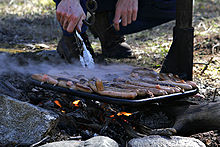
Australian "snags" cooking on a campfire
Australian sausages have traditionally been made with
beef,
pork and
chicken, while recently game meats such as
kangaroo have been used that typically have much less fat.
English style sausages, known colloquially as "snags", come in two varieties: thin, that resemble an English 'breakfast' sausage, and thick, known as 'Merryland' in South Australia. These types of sausage are popular at
barbecues, and can be purchased from any butcher or supermarket.
Devon is a spiced pork sausage similar to
Bologna sausage and
Gelbwurst. It is usually made in a large diameter, and often thinly sliced and eaten cold in sandwiches.
Mettwurst and other German-style sausages are highly popular in
South Australia, often made in towns like
Hahndorf and
Tanunda, due to the large German immigration to the state during early settlement. Mettwurst is usually sliced, and eaten cold on sandwiches or alone as a snack.
A local variation on
cabanossi, developed by Italian migrants after World War II using local cuts of meat, is a popular snack at parties.
The Don small goods company developed a spiced snack-style sausage based on the cabanossi in 1991 called Twiggy Sticks.
New Zealand
Sausage rolls are a popular snack and party food, as are
saveloys,
cheerios, and locally manufactured
cabanossi. Traditional sausages similar to English bangers are eaten throughout the country; these are usually made of finely ground beef or mutton
[23] with breadcrumbs, very mildly spiced, stuffed into an edible collagen casing which crisps and splits when fried. These may be eaten for breakfast, lunch or dinner. In recent years, many international and exotic sausages have also become widely available in NZ.
[24]
Other variations

Kabosi, shells, and cheese
Sausages are almost always fried in oil, served for any meal, particularly
breakfast or
lunch and often "sweet sausages" have been created which are made with any of the above: dried fruit, nuts, caramel and chocolate, bound with butter and sugar. These sweet sausages are refrigerated rather than fried and usually, however, served for dessert rather than as part of a savory course.
Sausages can also be modified to use indigenous ingredients. Mexican styles add oregano and the
guajillo red pepper to the Spanish
chorizo to give it an even hotter spicy touch.
Certain sausages also contain ingredients such as cheese and apple, or types of vegetable.
Vegetarian sausage
 | Wikibooks Cookbook has a recipe/module on
|
Vegetarian and
vegan sausages are also available in some countries, or can be made from scratch.
[26] These may be made from
tofu,
seitan,
nuts,
pulses,
mycoprotein,
soya protein,
vegetables or any combination of similar ingredients that will hold together during cooking.
[27] These sausages, like most meat-replacement products, generally fall into two camps: some are shaped, colored, flavored, etc. to replicate the taste and texture of meat as accurately as possible; others such as the
Glamorgan sausage rely on spices and vegetables to lend their natural flavor to the product and no attempt is made to imitate meat.
[28]
While not vegetarian, the soya sausage was invented 1916 in Germany. First known as
Kölner Wurst ("Cologne Sausage") by later German Chancellor
Konrad Adenauer (1876–1967).
[29]
Gallery
-
-
-
Two sausage rolls on a plate
-
-
-
-
Yam mu yo, a Thai sausage salad
-
-